Starting July 8, 2026, CPSC electronic filing (eFiling) will be fully enforced. Amazon and Temu sellers who confuse CPSC, CPC, and GCC may face certificate invalidation, customs clearance rejections, product delisting, and cargo inspection or seizure.
NBTS, a certified testing laboratory with CPSC registration, has been selected as a compliance-recognized lab by major cross-border e-commerce platforms. This article integrates practical experience in laboratory testing and customs declaration to clarify the definitions, key differences among the three, and the new requirements for linking certifications with electronic declarations. It aims to help exporting enterprises strengthen their compliance systems in the U.S. market and mitigate operational risks.

First, clarify the basic definitions: the relationship among CPSC, CPC, and GCC
CPSC: Consumer Product Safety Commission (regulatory body, rule-making authority)
The full name is Consumer Product Safety Commission. It is the U.S. government's designated regulatory agency for consumer product safety and serves as the primary body responsible for establishing and managing the national consumer product compliance system. All CPC and GCC certification standards, as well as the new eFiling electronic reporting requirements, are uniformly issued and enforced by CPSC.
Jurisdiction: All consumer products imported into the United States or sold and distributed domestically, including thousands of product categories such as toys, children's clothing, children's furniture, bicycles, lighters, fashion accessories, and cosmetics.
Companies must provide corresponding compliance documentation: CPC certificates for children's products, and GCC certificates for general adult products;
2026 latest mandatory regulation: All regulated consumer goods must complete CPSC eFiling electronic declaration prior to customs clearance, with certificate information synchronized to the CPSC database and cross-verified through the海关 ACE system.
Analogy: The CPSC is like a traffic police officer, setting market access rules and enforcing compliance by inspecting non-compliant products; the CPC/GCC is like a vehicle registration certificate, proving your product meets standards and allowing it to be sold and distributed in the U.S. market.
CPC (Children's Product Certificate): Children's Product Certificate
Required exclusively for products intended for use by children 12 years of age and younger, this is a legally mandated document under the CPSIA Act. Without a valid CPC certificate, goods cannot be cleared through U.S. customs or placed on the market for sale.
Hard Core Threshold (NBTS Key Risk Reminder)
1. Testing laboratories must be officially accredited by CPSC
The sole valid foundation for a CPC certificate is the third-party test report issued by a CPSC-recognized laboratory. Reports from unregistered or non-accredited labs are not accepted by customs, CPSC, Amazon, or Temu, and will result in immediate invalidation of the certificate, cargo detention, and clearance failure.
NBTS is fully listed in the CPSC's official laboratory directory across all product categories, enabling test reports to be directly used for CPC certification and eFiling electronic submissions—ensuring compliance for both customs clearance and platform requirements with a single testing process.
2. Statutory Mandatory Testing Requirements
Total lead content, phthalates, small parts suffocation hazard, sharp edges/points, flammability performance, structural stability of children's furniture, and risk of cord entanglement—these are all required to meet full compliance for all children's products.
3. Mandatory Product Traceability Labeling (CPSIA Requirement)
Each children's product and its outer packaging must bear a printed traceability label containing the production batch, country of origin, and complete contact information of the U.S. importer. Failure to include such labels during CPSC market sampling or product recall verification may result in substantial penalties and removal from all sales platforms.
4. Certificate issuance responsibility is clearly defined; the laboratory only provides test reports
The legal responsibility for CPC certificate issuance lies with the U.S. importer or domestic brand manufacturer; the laboratory only issues compliance test reports and has no authority to directly issue CPC certificates.
CPC Compliant Product Categories
Children's toys, baby clothing, walkers, children's high chairs, children's stationery, pacifiers, children's jewelry, infant and toddler bedding, and other products intended for use by children 12 years old and under.
GCC (General Certificate of Conformity): General Certificate of Conformity
Applicable to consumer products for adults aged 12 and over, covering only product categories for which the CPSC has explicitly issued mandatory safety standards. It serves as a compliance declaration document in place of CPC for adult products.
Four Key Differences Between GCC and CPC
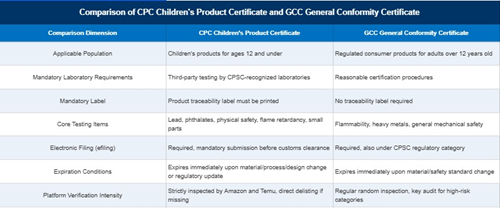
Mandatory eFiling: Bridging the Key Link Between CPC/GCC and Customs
Key Changes in the New Regulations (NBTS Practical Interpretation)
Old rule:After goods arrive at the port, companies must submit paper or PDF versions of CPC/GCC during customs random inspections; if not inspected, goods can clear customs without examination, leading many sellers to take chances.
New Rule (Enforced as of July 8, 2026): All CPSC-regulated imported goods must complete electronic declaration prior to arrival at port. The seven core data items from the CPC/GCC certificate must be entered into the Customs ACE system and the CPSC product registration database. The customs system will automatically verify data consistency; shipments without valid electronic records will be seized and denied release. A grace period for Free Trade Zone (FTZ) goods extends until January 8, 2027.
eFiling electronic filing: 7 core registration data items that must be collected: https://mp.weixin.qq.com/s/YGFNL-VcAJ02ug8aHI8o7g?scene=1

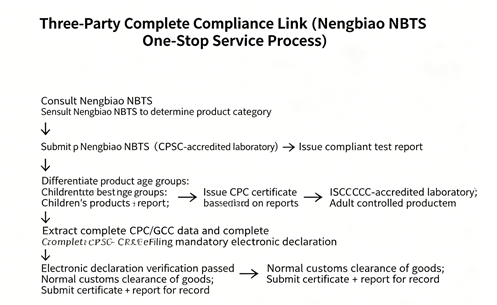
Complete and compliant process for all three parties (NBTS one-stop service workflow)
Practical Advice from NBTS for Sellers (You Should Act Now)
As the mandatory deadline of July 8, 2026 approaches, eFiling is currently in a voluntary participation phase—but savvy sellers are already streamlining the process.
Step 1: Conduct a "Certificate Inventory"
Evaluate each SKU individually: Is it a children's product (CPC), a non-children's product subject to CPSC regulations (GCC), or a category not regulated by CPSC (e.g., food contact products handled separately under FDA—don't mix them up). Misclassifying = incorrect certificates.
Step 2: Verify Laboratory Qualifications
CPC test reports must be issued by a laboratory on the CPSC's official list of accredited laboratories (available at CPSC.gov), not just any ISO 17025-certified lab. The report must also follow the correct standard version (e.g., ASTM F963-23 has replaced F963-17).
Step 3: Register a Business Account with the CPSC Product Registry
The system is already set up. Invite your partner laboratories and factory contacts into the account system, create product files in advance, and obtain product registration numbers so you won't be scrambling when July arrives.
Step 4: Internal Data Governance (This is the most challenging step)
eFiling has exposed an issue many sellers previously overlooked: certificate information is scattered across Excel files, WeChat chat records, and folders. The new regulations require structured, traceable data with each record uniquely linked to a product. The more SKUs you have, the sooner you need to make adjustments.
Step 5: Align Responsibilities with Customs Broker/Forwarder
The legal liability for eFiling lies with the Importer of Record—the U.S. company. However, the data originates from Chinese factories or testing agencies. Both parties must agree in advance on who provides which data fields, who verifies them, and who submits the information to ACE.
The relationship among CPSC, CPC, and GCC essentially forms a complete chain of "legislator ,compliance certificate ,digital enforcement gateway." eFiling is not just another form to fill out; it transforms compliance from a "post-event luck-based question" into a "pre-event mandatory requirement."

 Hello, welcome to visit the official website of Nengbiao Testing!
 Website map
 Contact
 ENGLISH


